

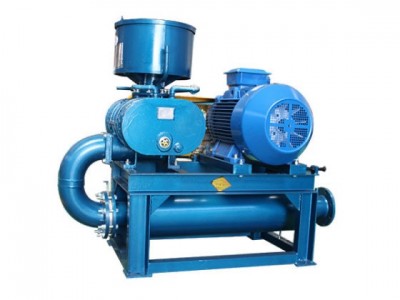



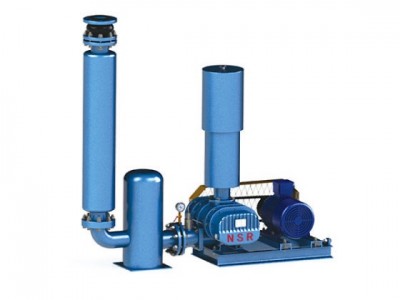
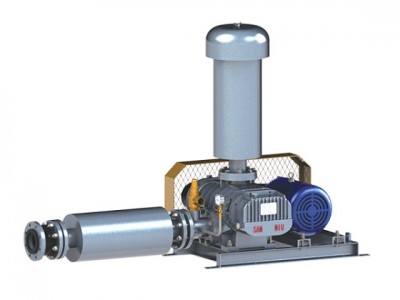
Blower selection
1. Selection steps
a. Usage: distinguish between blast use and vacuum use,
b. Gas properties: air, gas or other media
c. Working condition parameters: intake air temperature, intake air pressure, pressure boost (exhaust pressure or vacuum degree), flow rate, and requirements for exhaust temperature and noise values [[[DTI18N_TAG _7]]]d. Environmental conditions: installation site, local atmospheric pressure, average annual temperature, etc.
Roots blower/Roots vacuum pump can be converted as described in this sample to determine the flow rate. When it comes to special media such as hydrogen, ammonia, mixed gases, etc., you can contact our company's technical department for collaborative determination.
NSR features: [[[DTI18 N_TAG_13]]]
(1) The fan inlet adopts a spiral type. When the impeller rotates, the top boss is cut into the casing through the spiral, forming a cavity that opens and closes sequentially, thereby reducing the pulsation of the fan.
(2) The rotor adopts a more advanced profile, with an area utilization coefficient of 0.53. The volumetric efficiency is increased by 5% to 8% when the voltage is boosted to 98kPa, and the noise is reduced by about 5dB (A).
(3) The rotors are all produced by precision CNC special equipment (CNC two-way surface planer) and quality inspected by the three-coordinate measuring center, so there is no performance error between each fan. The rotor part has all undergone dynamic and static balancing tests before assembly, so the vibration of the fan is extremely small.
(4) High-precision grinding gears are used to reduce mechanical noise. The gear accuracy is level 5 accuracy required by the national standard GB/T 10095-2008.
(5) The new fully enclosed oil tank and lubrication system ensures that the fan does not spray oil or leak oil, and eliminates on-site pollution caused by the oil spray and oil leakage of the old Roots blower.
(6) Cooperate with an acoustic research institute in Beijing to construct an “echo gallery” structure on the wall panel. This structure not only helps the lubricating oil dissipate heat, but also reduces mechanical noise. In practice, this structure can effectively reduce noise by about 3-5dB(A).
(7) With the establishment and improvement of the company's quality management and production management systems, the interchangeability of various components of the wind turbine has been realized. This reduces production costs and shortens the delivery period. Generally, this fan has an appropriate amount of inventory and can be supplied on the same day.